Sunday, May 17, 2009

Slow Funk

Hi,

A simple slow funk exercise where you can repeat over and over again.


Don't rush and try to feel the groove.

Have fun.

Monday, May 04, 2009

Using 9th

Hi,

This bassline make use of 9th. Get your friend to play a G chord and C chord.


Have fun.

Thursday, April 23, 2009

Diatonic Harmony

Hi,

The term diatonic means that the notes come from the same key.

Chords and notes that fall outside those made from these scales are not diatonic.

In the key of G major,the seven notes are– G, A, B, C, D, E, and F#.

A Cmaj7 is a diatonic chord in the key of G major since the notes are - C E G B which fall inside the G major scale.

A Cm7 is not a diatonic chord in the key of G major since the notes are - C Eb G Bb,
where Eb and Bb fall outside of the G major scale.

Hope this is clear.

Thanks

Friday, April 03, 2009

Dominant 7th

Hi,

Dominant 7th Chord is frequently used in many genres especially in Blues.


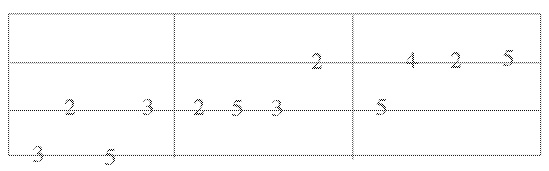
The above example is the pattern and notes for G dominant 7th chord.
All you need to do is study the fingering pattern and you can form other dominant chords easily.

Formula for Dom7th chord - 1 3 5 b7

G7 chord consist of G, B, D, F.

As for finger position you can try:
R (middle)
3 (index)
5 (last)
b7(middle)

Have fun.

Saturday, March 07, 2009

Guitar plucking on Bass

Hi,

Bass can sound melodic too.

This article talks about plucking the bass like a guitar.


Use your thumb to hit the root note, follow by your index finger plucking on the open D string and middle finger plucking on the open G string.

For the left hand, you can use your index finger to fret the root note, ring finger to fret the open D string and last finger to fret the open G string.

Follow the above tab and you should be able to get what I'm trying to say.

Have fun.

Wednesday, February 04, 2009

Basic Flea Slap Style

Hi,

For those who are interested in Flea's slap style, this lesson is a good starter.


Slap on the C and hammer on to D, followed by a mute slap and pop.

The mute slap and pop is crucial to create the percussive feel.

Try it slow and as you increase the speed, you will be amazed that such a simple exercise make you sound so experience.

Enjoy!

Tuesday, January 13, 2009

Relative Scale

Hi,

Every major scale has a relative minor scale and every minor scale a relative major.

They share the same notes.

For example, a G major scale and a E minor scale are relative scales.

The notes in a G major scale are - G A B C D E F# G (G Ionian)

The notes in a E minor scale are - E F# G A B C D E (E Aeolian)

The different is the starting note.

The root of the relative minor is always the sixth note of the major scale.

The root of the relative major is always the third note of the minor scale.

This work for all the keys. Let's try key of C.

The notes in a C major scale are - C D E F G A B C (C Ionian)

The notes in a A minor scale are - A B C D E F G A (A Aeolian)

Have fun

Friday, January 02, 2009

Chord Tone Improvisation

Hi,

One of the best ways to create bassline is by using chord tone,which are the notes in a chord.

Let use Cmaj7 for an example.

The notes in a Cmaj7 are C E G B (1 3 5 7).

What people tend to do is when the other musicians strike a Cmaj7 chord, we bass player naturally play the C, which is the root note,or sometimes followed by E -> G-> B than to the next chord.

You can start simple improvisation by experimenting different placement of the note. i.e 3 1 5 7 or 5 1 3 7, or 3 5 1 7 or 7 5 3 1 and which ever ways you can come out with.

By doing this, you will break the fix pattern of playing 1->3->5->7.

Hope this helps.

Have fun

Monday, December 01, 2008

Arpeggio Exercise

Hi,

Arpeggio is playing the notes in a chord one by one instead of simultaneously.

In a G chord, the notes are G B D.

This arpeggio exercise is in G and helps to make it sound more interesting.


Hopefully this can give you some ideas to use arpeggio to create your bassline.

Have fun.

Saturday, November 01, 2008

G Major Scale Octave Exercise

Hi,

This G major Scale Octave exercise can help you to practice for Stanley Clarke's "School Day".

First you try to play it using finger style, next move to slapping and popping.


When you pop, try to keep the note short.

Try to practice it with a drum machine or metronome.

Have Fun.

Thursday, October 02, 2008

Different Tuning

Hi,

Most 4 string bass player will probably tune their bass with the standard E A D G.

We are expose to players like Stanley Clarke and Victor Wooten who tuned their bass to
A D G C(tenor bass).

Some people wonder if they are to tune the G string up to C or how?

For me, I will buy the high C string from a 6 string pack and use it instead.
Another common tuning is the drop D - D A D G. Either you can manually tune down to D or fix in the Drop D hipshot.

Standard 5 string bass tuning is B E A D G, but you can also tune it to E A D G C (standard+tenor bass). Many bassists tune it this way as they wanted to do more melodic stuff on their bass like Steve Swallow and Dominique Di Piazza.

I also see some people tune their 5 string to A E A D G(Drop D concept).

Standard 6 string tuning is B E A D G C. You can also tune it E A D G C F or F# B E A D G.
I personally haven't tried it before but I'm sure it is nothing new.

Michael Manring Hyper Bass is another interesting instrument where the tuning is C F Bb Eb.
Different songs he will tune it differently. He is so scary.
You guys can read up more if you like.

Cheers

Saturday, September 20, 2008

SMV Thunder Tour (Singapore)


It was my privilege to witness the historical assemblage of Stanley Clarke, Marcus Miller and Victor Wooten in their once-in-a-lifetime Asian tour.

Nothing beats watching them real live on stage.

Most of the songs played were from their Thunder album.

I personally enjoyed Marcus's bass clarinet playing and slapping tone, Victor's looping solo and Stanley's double bass percussive slap and solo.

The show ended with the famous "School Day" tune where the whole audience stood up and clap along.

I believe most musicians that attended the concert is further motivated to bring music to a higher level.

Cheers

Monday, September 01, 2008

Basic Harmonics

Hi,

Adding harmonics in your bass playing can be pretty musical.

The example given show a note pressed and the <5> is harmonics on the 5th fret.

You just need to place your finger lightly against the string but not touching the fret.

Try plucking it nearer to the bridge pickup and have a higher treble setting on your amp.

If successful, you will hear an unique chime sound.


For more advance study, please listen to:
1. Jaco Pastorius
2. Stu Hamm
3. Victor Wooten
4. Steve Bailey
5. Vail Johnson
6. Victor Bailey
7. Jeff Berlin
8. Billy Sheehan
9. John Myung
10. Michael Manring
11. and etc

Have fun

Monday, August 04, 2008

Melodic Minor Scale

Hi,

Another scale that you may want to consider having in your toolbox is the Melodic Minor Scale.

The notes in the C Major Scale - C D E F G A B C (you should know by now :))

The formula for Melodic Minor Scale - 1 2 b3 4 5 6 7 1(8) = C D Eb F G A B C

We can apply this scale on a minor chord but preferably not on a minor 7 chord. Try it on a Minor Maj7 Chord.

You can also apply the C Melodic Minor Scale on the (V7) which is G7 in the key of C

The notes in a G7 = G B D F, which are also inside the C Melodic Minor Scale.

You can try the D Melodic Minor Scale, F Melodic Minor Scale and the Ab Melodic Minor Scale.

Have fun.

Friday, July 25, 2008

Walk Down

Hi,

G D7 Em7 Bm7 C G Am7 D7

Find the above chord progression familiar? Maybe for some of you.

The natural approach for beginners are to play the root note.

To make things more smooth, we can use the walk down approach.

Something like this - G D7/F# Em7 Bm7 C G/B Am7 D7

Bassist will play the slash note on the right - e.g D7/F#, we play the F# note and let the guitarist or pianist play the D7 chord.

Some people call this "inversion".

Basically, instead of playing the root note which is D in the D7 chord,
we play the 3rd which is the F#.

As mentioned in our previous lesson, Dominant chord are formed by the formula 1 3 5 b7

D7 = D F# A C

Therefore we can use the G to D7/F# to Em7, creating a walk down.

Using the same approach we can apply it on the C G Am7 to become C G/B Am7

Since you can walk down, you can also walk up, depending on the chord progression.

Hope you enjoy this lesson.

Cheers

Thursday, July 03, 2008

Funk Groove

Hi,

Here is a simple exercise for those who are interested to learn Funk.


Important thing to take note is the ghost note and the Funk feel.

Chromatic scale was used as well.

Have fun

Sunday, June 08, 2008

2nd Dominant

Hi,

As some of you already know, the 5th degree in a Major scale family chord is a dominant chord.
I.e. G7 in the Key of C.

Looking at a common chord progression(1 6 2 5) in key of C , the chords are C Am7 Dm7 G7.

Now, playing the same progression, instead of playing the Am7, play a A7 chord.

You will notice that the voicing is even more jazzy, creating a tension.

That is an example of applying the 2nd dominant.

You can try also changing the Dm7 to a D7 chord, but perhaps play a Am7 instead of A7.

Experiment around.

Have fun.

Monday, June 02, 2008

Bass Workshop


Praise God for the first Bass workshop conducted on 1st June 2008.
There were sharing of good bass players in the world and watching their video.
There were teaching and discussion on melody, harmonics and techniques.
Most importantly, everyone enjoyed themselves.

Sunday, May 04, 2008

Slap Exercise


Hi,

The key to slapping the bass and allowing people to enjoy and tap along with you, is by adding ghost notes to your playing.

The above is a cool slap groove which is not too complicated but yet a good practice.

Make sure that the ghost notes (X) can be heard.

Have fun

Sunday, April 06, 2008

Rock Exercise


Hi,

This exercise is simple but yet fun when play fast.

Try it slow first and slowly build up the speed.

If you do not have a band or drum machine to practice with, can use an online metronome.

The basic chords are G C D C G.

Have you have queries, please feel free to email me.

Enjoy and have fun.

Friday, March 21, 2008

Blues Scale

Hi,

The blues scale is a pretty common scale and sometimes we use it without even realizing it.

Remember the pentatonic scale? Say G minor pentatonic, its G Bb C D F right?

You need to add a flat 5th into the minor pentatonic to form the blues scale.

So the G blues scale will be G Bb C C# D F.

Hope this information helps.

Cheers

Wednesday, February 27, 2008

7th chords

Hi,

Often you will see chords like Cmaj7 or Cm7 and etc.

Basically they are just chords with a 7th note.

As we already know, chords are formed by 1+3+5.

A Major 7th chord will be 1+3+5+7.
E.g Cmaj7 - C + E + G + B

For Minor 7th chord, it will be 1+b3+5+b7
E.g Cm7 - C + Eb + G+ Bb

For Dominant 7th chord, it will be 1+3+5+b7
E.g C7 - C E G Bb

How about Sus 7th chord? It will be 1 +4+5+b7
E.g C7sus - C F G Bb

Trying adding the 7th to your chord now. :)

Sunday, February 03, 2008

Chords from Major Scale

Hi,

Chords are 2 or more notes pressed together simultaneously.

From the major scales, we can form 7 basic chords.

Let's take a look at the notes in the C major scale: C D E F G A B C

To form a basic chord, we can press the 1 and the 3 together.

If 1 = C ,E will be 3, we get a C chord.

Now we move to D. If D= 1 , F = 3, that is a Dm chord.

Next, E=1 than 3 must be G, that is a Em chord.

F=1, A=3, we get a F chord.

G=1, B=3, we get a G chord.

A=1, C= 3, that is a Am chord.

B=1, D=3, a Bm chord is formed.

The basic chords in a C major scales are: C Dm Em F G Am Bm C.

Some people play it this way: Cmaj7 Dm7 Em7 Fmaj7 G7 Am7 Bm7(b5) Cmaj7.

Have fun.

Monday, January 28, 2008

Minor Pentatonic Scale

Hi,

We have covered the major pentatonic scale in the previous post, let's take a look at the minor pentatonic scale.

Minor pentatonic scale consist of 5 notes from the minor scale.

The notes in a G minor pentatonic scale are: G Bb C D F (a common fingering pattern).

So when an instrument play the Gm or Gm7 chord, you can play the notes in the G minor pentatonic scale.

Have Fun.

Monday, January 07, 2008

Pentatonic Scale (Amazing Grace)

Hi,

One of the most useful scales that help guitarists and bass players is the pentatonic scale.

We will look into the major pentatonic scale for now.

Major pentatonic scale consist of 5 notes from the major scale.

The notes in G major pentatonic scale are : G A B D E (a common fingering pattern).

You can play the melody of the song, Amazing Grace by using the G major pentatonic scale.

If you would like to play using harmonics, find out the melody first,follow by the harmonics on the bass frets and pluck near the bridge pick up(turn up the treble).

Have Fun.

Sunday, December 16, 2007

Dorian Groove

Hi,

This exercise is based on the G Dorian Scale.

Sound pretty interesting when you play it fast.

Here we go,

G Bb C, G C D, G E F, G F G, G

To make it more groovy, you can add a ghost note (X).

Like this,

G X Bb C, G X C D, G X E F, G X F G, G

Start slow and gradually increase the tempo.

Enjoy

Tuesday, November 20, 2007

Basic Walking Bass


Walking Bass lines are used in rock, blues, jazz, gospel and many other genres.

I would like to share the basic idea of building walking bass lines using chord tones.

Let's try playing a 4 chords progression in the key of G.

The chords are - Am7|D7 |Gmaj7| Cmaj7|.

We need to identify the notes in these chords.

Am7 - A C E G
D7 - D F# A C
Gmaj7 - G B D F#
Cmaj7 - C E G B

Now, each note is a quarter note (1/4).
The timing is like this - 1234|1234|1234|1234 (one note each).
The basic idea is always to play the root notes on the "1".
You can try different arrangement of the notes,
the exercise below is an example of what you can play.

e.g. ACEC|DCAF#|GBDG|CBDG

Get a guitarist to play along with you and experiment which notes sound better.

More complicated walking bass lines can be formed using modes,passing notes and need not start with the root note.

Have fun.

Wednesday, November 14, 2007

Famous Slapper

To be a good slapper on the bass, one need to have a good sense of rhythm and know what notes to hit (Ghost notes play a big part in funk slap style).

Would like to name a few good bass players whom we can study.

1) Stanley Clarke
2) Victor Wooten
3) Stu Hamm
4) Abraham Laboriel
5) Louis Johnson
6) Larry Graham
7) Mark King
8) Marcus Miller
9) Vail Johnson
10) Flea

There are many others in the world but these 10 listed are some of my favourites.

Play around with your amp settings, pickup selection, frequency cuts to get the tone you like.

Cheers

Thursday, November 01, 2007

Night School


Hi,

For those who are familiar with Stanley Clarke, will surely know this song "School Day".

There is this part at his lastest DVD titled Night School, where many popular bass players improvise School Day with their style.

Some of the bass players include Stu Hamm, Brian Bromberg, Jimmy Johnson, Marcus Miller, Wayman Tisdale and etc.

Grab a copy now. :)

Saturday, October 20, 2007

5 Steps for beginners


Recently I was sharing with some friends how to improve their playing.

I figure that most people these days just want to play but not learn the theory.

One reason I feel that theory is important - You will know what notes you can and cannot play.

Below are 5 steps to give self taught beginners a kick start.

1) Memorise the fretboard - Start with the first 5 frets (all strings) and slowly move up.

2) Learn the Major Chords and Scales ( Major Chord = 135, Major scale = 221 2221)

3) Practice plucking the strings alternating with 2 fingers (right hand)

4) Practice with a metronome / drum machine ( Start with 1 note per click)

5) Choose a song that you love and hear how the bassist play (Ask a friend or teacher to guide you)

Techniques like slapping, popping, tapping, chords, harmonics and etc are to help produce music.Learning to apply the techniques to your music is the challenge.

Internet resources, videos and books are your friends.
We are constantly learning new stuffs so don't feel pressure if you need more time. Email me if you need any elaboration.

Cheers

Sunday, August 26, 2007

Minor chord family

Dear all,

Was great to see Stu Hamm performance live at the art house on 23rd August 07.

I think some who came were just accompanying their friends but nevertheless, I still enjoy myself.

For those who listen to Stu's music, you realize that he compose quite a lot of songs in minor key.

Let's refresh on the chords in the major key.

In the key of C - C Dm7 Em7 F G7 Am Bm7(b5) C

Try tapping that and you can play the Prelude in C.

Next the minor chord in key of A (based on A natural minor) - Am Bm7(b5) C Dm7 Em7 F G7 Am.

Do check out the minor chord family for Harmonic Minor and Melodic Minor.

Cheers,

Ben

Tuesday, June 05, 2007

Basic Tapping


Hi,

One way to make the bass sound more melodic is by playing chords.

Tapping can achieve a guitar plucking/piano playing type of sound.

The motion is similar as hammer on.

We will try a G chord for this explanation.
The 4 notes that you are going to tap are G (root) D (5th) G (octave) B (10th).
The fingering is similar as playing bar chord on the guitar.
Now your left hand fore finger on the root, followed by right hand fore finger on 5th , middle on octave and left ring finger on the 10th.

Give it a try :)

Wednesday, May 30, 2007

Melodic Lead Bass


Former NBA Star, Wayman Tisdale is one of the better and few bassists that play melodic lead lines throughout the whole song. Wayman Tisdale is a left handed player. If you like smooth jazz and sweet bass lines, than check him out.

The album "Way Up" is what he consider one of his most fulfill title so far.
For more information and sample of the album, please visit www.waymantisdale.com

Thursday, May 24, 2007

Grooving for Heaven series


Hi,

For those who do not know Norm Stockton, you probably also didn't know that he produced 4 instructional DVDs called the Grooving for Heaven Series.

I encourage all beginners to grab volume 1 and learn the basics techniques and theory. If you have benefited from it, then try vol 2-4.

Do note that the notation are sold separately.

You can take a look at the video example from http://www.normstockton.com

Have fun!

Saturday, April 28, 2007

Bass Floor Pod


Hi,

Want to get a cheaper Line 6 effects?

Check out the new Bass Floor Pod.

The effect comes with 5 different bass amp model and the knob make it easy for you to choose.

Not only that, the Bass Floor Pod has an OPTO compressor and effects like octaver,envelope filter and chorus, making it possible to get a variety of sound.

The in-built pedal definitely make it an essential tool for live performance.

Check it out at http://line6.com for demos and more information.

Any comments? Value for money?

Sunday, April 15, 2007

Simple Hammer on Tap

Hi,

Will like to share with you a simple hammer on tap technique that can sound real fast and not difficult to execute.
Basically, it is just a hammer on with your left hand and a right hand tap.

A right hand tap is achieve by simply pressing the string onto the fingerboard with the tip of your finger.
We will use the G string for this example.

Place you left hand index finger on the 9th fret( E) followed by a hammer on the 10th fret( F) with your middle finger followed by your right index finger tap on the 12th fret (G).

Subsequently, you just hold your left index finger down and alternate between your left hand middle finger(hammer on) and right hand index finger(tap).

When you are comfortable with this position, try moving your right hand index finger to the 14th fret and back to 12th fret. Left hand remain in the same motion.

Give it a try.

Cheers,

Sunday, March 25, 2007

Slap Pop Exercise

Hi,

This is a nice and not too difficult slap pop exercise.

You can loop it over and over til you get a nice slap tone and also slowly increase the tempo.

Just note that the G and A are triplets.

Slap G on the 3rd fret twice and pop the octave G on the 5th fret.

You can break it into 3 parts

1. TTPT
2. TTP - triplets (123)
3. TTP - triplets (123)


Ok have fun

Thursday, March 22, 2007

Rub Alcohol

Someone once asked me if it will improve his bass playing speed by rubbing alcohol on his hands.

My answer to him was practice, not rubbing alcohol or drinking.

Anyway why some people rub alcohol on their hands is to prevent the strings from rusting. By doing so, it will keep your hands dry.

You may also use it as a string cleaner.

I have dry hands so not a problem for me.

Sweaty palms, this is your helping star :)

Friday, March 16, 2007

Adjusting Intonation


To adjust your bass's intonation is as important as adjusting the neck action, but slightly easier.

The tools required are screwdriver and a tuner.

When tuning the screw at the bridge, it will move the saddle either forward or backward.

1. Now hold a note at the 12th fret and check it with your tuner.

2. If the note is too sharp that mean the string is too short. Move the saddle away from the neck.

3. Tune again to check if it is accurate.

If you are not confident to do it yourself, do send in and get the pros to do it. Also get them to adjust your action as well.

Cheers

Sunday, March 04, 2007

Arpeggios

What are arpeggios?
Arpeggios are chords pluck note by note instead of pressing all at the same time.

When guitarist mention 'play arpeggios', they usually pluck string by string on the chord that they are pressing.
For us bass players, we do the same as well.

As we already know, a chord is formed by pressing root 3rd and 5th together.

So just press note by note of the chord now. e.g G arpeggio - G B D (3rd fret on E string, 2nd fret on A string and 5th fret on A string).


This is useful when your band is playing one bar of G, instead of just holding the G note, you can play the G arpeggio - G B D G.

Now trying going further up the fretboard.

Starting with:
G B D (3rd fret on E string, 2nd fret on A string and 5th fret on A string),
followed by:
G B D G ( 5th fret on the D string, 9th fret on the D string, 7th fret on the G string and 12th fret on the G string).

By doing this exercise, you won't be restricted to just play within the first few frets(obtain different tone) and it also help you to be more familiar with the fretboard.

Try reversing back from the high G ( 12th on the G string) back to the low G ( 3rd fret on the E string).

Have fun!

Saturday, February 17, 2007

Scales in C

Hello,

Today, I will list down 7 scales in key of C which is often used.
I have mentioned some of the scales before in my previous post.
If you are interested to scroll through, just subscribe to my RSS and place it on your browser's toolbar. :)

Ok, although it is more easy for you to practice the fingering if I post the tabs,
but I think it is good that you can find out the position of the notes this time.
You can either use the C on the 3rd fret of the A string or go further up the fretboard.

C Major - C D E F G A B C
C Mixolydian - C D E F G A Bb C
C Dorian - C D Eb F G A Bb C
C Natural Minor - C D Eb F G Ab Bb C
C Major Pentatonic - C D E G A C
C Minor Pentatonic - C Eb F G Bb C
C Blues - C Eb F F# G Bb C

There are lot of good articles out there to explain how you can apply the above scales.

Have fun!

Sunday, February 11, 2007

Slap Bass DVD


Hi, usually the good slap materials out there are pretty dry and those fancy ones we can't learn much.
I would like to recommend this Dvd by Ed Friedland - Slap Bass (The Ultimate Guide).
This Dvd provides the essential of playing slap style(beginner, intermediate) and it's not boring.

You will learn the techniques of playing triplets, 16th notes and more using the slap style. Very useful material to guide you play like Louis Johnson, Marcus Miller, Victor Wooten and etc.
Go for it man!!

Friday, February 02, 2007

Basic Rhythm and Note Duration

Thought this might be useful. You can read up from the web for something more complete.
I'm just giving a brief explanation. :)

Play on the "Bold" only and count out loud.
e.g Playing a whole note with G - G 2 3 4 G 2 3 4 G 2 3 4 G 2 3 4


Whole Note - 1 2 3 4 1 2 34 1 2 3 4 1 2 3 4

Half Note - 1 2 3 4 1 2 3 4 1 2 3 4 1 2 3 4

Quarter Note - 1 2 3 4 1 2 3 4 1 2 3 4 1 2 3 4

Eighth Note - 1 & 2 & 3 & 4 1 & 2 & 3 & 4 1 & 2 & 3 & 4 1 & 2 & 3 & 4

Sixteenth Note -
1 e & a 2 e & a 3 e & a 4 e & a 1 e & a 2 e & a 3 e & a 4 e & a


Hope that will give you a headstart.

Thursday, January 18, 2007

Are Tabs evil?

Hi,

I came across quite a few beginners who learnt by memorizing the notes position without knowing what notes they are pressing.
Some learnt by reading using tabs.

So is it wrong or not very musically inclined to learn a song by reading tabs instead of transcribing with your ears?

In my opinion, one should strike a balance. Firstly, you definitely need to know what notes you are pressing and not just memorize by position (i.e 5th fret on D string is a G note).

Tabs are good tools for beginners to kickstart, but as you grow musically, you should try to use your hearing and figure out the notes.
You may occasionally referred to it when certain songs or bass lines are difficult to transcribe.

After you look at the tabs, see if you can derive the theory behind it and not blindly follow. Maybe from the tabs you learnt that by pressing this note and that note it form a certain chords. See, you are learning something.

Be the master over your learning tool and instrument! :d

Cheers

Sunday, January 07, 2007

Hartke Bass Attack

Hi,

Just a short sharing of how I use the Harkte Bass Attack VXL Tone Shaper Pre Amp cum DI(Direct Input) if you have no time to read the manual.

1. Plug in your bass to the input and adjust the "Bass" and "Treble". 5 is neutral. My "Bass" is 3 and "Treble" is 6.

2. Step on the "ON/OFF" switch and adjust the "Harmonics", "Mix" and "Brite". " My "Harmonics" is at 4, "Mix" at 1 O'clock(not too dry) and "Brite" at 3.

3. Step on the "SHAPE" switch and adjust the "Shape" knob. I set mine at 850Hz frequency.
For "Shape", it can affect your slapping tone.

For this setting, it depend what sound you want and how you adjust your output's EQ. It also depend how you adjust your bass's preamp(if any). You can get the pure sound of the bass attack by connecting to the effect loop of your amp.

If your bass has a built in preamp, adjust the sound you like first before setting the "Harmonics", "Mix" and "Brite".

Take some time to explore and experiment.

A typical set up propose by the manual is, your bass to input of Bass Attack,the XLR output or line output to mixer and parallel output to amp.

For me, instead of using the parallel output to amp, I used the line output and set the amp as my monitor.

Harkte Bass Attack is designed and engineered in the US by Samson Technologies. Made in China :)

Rugged Aluminium Chassis. You can use a 9V battery or DC adaptor.

Cheers

Sunday, December 31, 2006

Warm up exercise

If you are planning to play in a gig or practice for a longer duration, you can start off by doing some simple warm up exercise.

There are probably hundred of exercises for warm up, but today I'm going to introduce the spider scale. Most people will know it as chromatic scales.

On a 4 string bass starting from the E string.
Postion your left hand on the fretboard. One finger per fret and for right hand just play normal alternate fingering.
Start from the first fret, F(fore) F#(middle) G(ring) G#(pinky) than move to the A string and press the Bb B C C#.
Do the same fingering pattern for the D and G string.
Reverse the pattern. On the G string, B(pinky) Bb(ring) A(middle) Ab(fore) to D string and all the way back to the E string.

Now start from the 2nd fret on the E string and repeat what you have done. Once you reach the 12th fret your fingers should be warmed up.

You do not have to do it very fast. Start slow and build up the speed. Objective is to stretch your fingers and also get a clear tone. Speed is not the objective of this exercise, but eventually it will help you play fast.

Have fun and explore other patterns. As usual, you can also practice your slapping with the chromatic scale.

Cheers

Thursday, December 21, 2006

Ghost notes

Hi,

A simple ghost notes exercise to help you "feel" the groove.

Ghost notes are produce when you place your left hand lightly on the fretboard of and pluck with your right hand. Try to place your left hand in between the frets and not on the fret if not you will get the harmonics out.

Now try playing the G major scale as followed where "x" is the ghost note.

GxGGx AxAAx BxBBx CxCCx DxDDx ExEEx F#xF#F#x GxGGx. Simple?
you can also try slapping the exercise if you want.

You can also imagine the "x" to be like the snare drum. and the note to be the bass drum(ask your drummer friend if you are not sure which is the snare).

Try the above pattern on different scales and experiment other patterns.

Have fun!

Cheers,

Ben

Monday, November 27, 2006

Relative Minor

For those who have been grooving around might have come across this term 'relative minor'.

How I remember or recognise the relative minor of each key? Simple!!

For me, I know that the vi is the relative minor.

e.g. The relative minor for A is F#m,also because both keys have 3 #

So what do we do with this relative minor? Let's use Key of C to explain.

The notes in the Am scale are A B C D E F G A. Hmmm isn't that the same notes in the C major scale? Correct. Am scale in key of C is also called A Aeolian scale.

So when someone play a C chord, you can solo within the Am scale or C major scale.

Have fun!

Monday, November 20, 2006

1 3 5

Hi,

After you have memorize the fretboard on the bass guitar, it's time to create some simple bass lines.

If you have a song with chord progression like G Em C D, you should have no problem playing the root note (i.e G E C D )

You will sound right just playing the root note but now you also want to start playing a bit more. You can use 1 3 5 (notes inside a chord) to create something more interesting.

Let's write out the 135 in each chord:

G - G B D
Em - E G B
C - C E G
D - D F# A

Say I start with G and want to link to the next chord Em, I can play G B D E.
Next from Em I can play G B B C then E G G D

This is just the basic idea of creating bass line using 135. You can take it from here and explore which note sound better and try to get a nice line.

Cheers

Thursday, November 09, 2006

4,5,6 String Tuning

For those who are new to bass playing, you might want to know what are the common tuning for the 4,5 6 string bass. There are 7,8 12 string bass as well.
Anyway let's not stress ourselves.

4 string bass - E A D G ( E is the thickest string)
5 string bass - B E A D G ( B is the thickest string)
6 string bass - B E A D G C ( Same as 5 string but with additional high C)

Some people said that for beginner it is better to start with the 4 string bass as it is more easy to handle.
I think it is up to individual.
There are many people who started out playing 5 or 6 string too.

With the additional strings, you will have a wider range of voicing. A person who played 5 or 6 string bass does not mean that he or she is more superior than a 4 string bass player.
You can decide which bass to start with and put in effort to control it.

Here are a few famous bass players that you can listen and learn from.

4 string - Victor Wooten(He plays a tenor bass too A D G C), Marcus Miller, Jaco Pastorius.
5 string - Nathan East, Abraham Laboriel, Richard Bona
6 string - John Patitucci, Gerald Veasley, Jimmy Haslip

Victor Wooten plays in a band called Bela Fleck and the Flecktones. He has his own solo album as well.
Marcus Miller is more of a solo artist. For Jaco, you can find his solo album or some of the old Weather Report album. Jaco Pastorius Big Band is a tribute to him.

You can find Nathan East playing in some of Eric Clapton's album and the Fourplay.
Abraham Laboriel Sr has his own solo album and he played for many artists including Lee Ritenour, Stan Turrentine, George Benson and etc.
Richard bona was featured in Jaco Pastorius Big Band and has his own solo album.

John Patitucci has his own solo album. He played for Chick Corea in the akoustic and elektric band.
Gerald Veasley was featured in Jaco Pastorius Big Band and has his own solo album.
Jimmy Haslip is in a band called Yellowjackets. He was featured in Jaco Pastorius Big Band as well.

There are too many good bass players like Chuck Rainey, Stanley Clarke, Louis Johnson, John Myung, Stu hamm and etc. Take your time to listen to their music.

Thursday, October 26, 2006

Right Hand Technique

I guess there are many ways to increase one's fingering speed. One of them is to practice your scaling, plucking near to the bridge area.
Reason is simple since the tension is greater at the bridge area, it require more strength to pluck.
So as you practice more, your finger will be strengthen and hence can play faster and longer duration too.

Billy Sheenhan make use of his bass pickup and his 3 finger technique in order to play fast. You can check out his DVD to see his live examples.

Victor Wooten uses his unique thumb and finger technique. The concept is thumb down, thumb up, pluck with forefinger and pluck with middle finger. He teaches that on the bass Day 98 DVD. That is a "must watch" DVD for those who are interested to explore bass.

Abraham Laboriel uses Thumb follow by pluck with forefinger and middle finger. You can also learn about chords and thumping at his Beginning Funk Bass DVD.

Friday, October 06, 2006

Bass Strap

This is a simple but useful tip about bass strap.
Some people asked why when they practice a bass lick at home and it is smooth but when they jam with their friends, that bass lick has more difficulties to come out.

One possible reason is that the bass strap is not adjusted to the comfortable length when you stand and play, while at home it rested nicely on your lap.

If you want, you can practice at home with the strap on as if you are standing.
Many rock and heavy metal bass players like to put the bass near their waist. For people with long arms you can do that but might face slight difficulties when slapping.

cheers

Friday, September 22, 2006

Listen to them

Here is a list of bass players whom you can listen to.

  1. Abraham Laboriel
  2. Anthony Jackson
  3. Bill Dickens
  4. Billy Sheehan
  5. Brian Bomberg
  6. Bootsy Collins
  7. Chuck Rainey
  8. Chris Squire
  9. Christian McBride
  10. Ed Friedland
  11. Flea
  12. Francis Rocco Prestia
  13. Gary Grainger
  14. Gary Willis
  15. Geddy Lee ( Haven't hear him play)
  16. George Porter Jr
  17. Gerald Veasley
  18. Jaco Pastorius
  19. James Jamerson (I haven't hear him play but he is a legend)
  20. Jeff Berlin
  21. Jimmy Haslip
  22. Jimmy Johnson
  23. John Entwistle
  24. John Patitucci
  25. Larry Graham
  26. Louis Johnson
  27. Marcus Miller
  28. Mark King
  29. Michael Anthony
  30. Michael Manring
  31. Nathan East
  32. Noel Redding (Haven't hear him play)
  33. Norm Stockton
  34. Oteil Burbridge
  35. Paul McCartney
  36. Richard Bona
  37. Stanley Clarke
  38. Steve Bailey
  39. Steve Harris (Haven't hear him play)
  40. Sting
  41. Stu Hamm
  42. Tetsuo Sakurai
  43. Verdine White
  44. Victor Bailey
  45. Victor Lemonte Wooten
  46. Will Lee
That's all for now. There are too many good bass players in the world. Don't stop listening

Saturday, September 09, 2006

In The Pocket

We often ask ourselves (at least for me), how come a season player sounds more groovy when playing the exact same notes than that of an amatuer player.
Beside knowing how to accent certain notes and playing ghost notes to add some feel, the main reason is TIMING.

Top priority for a bass player in any genre of music is keeping time. Sorry it is not just the drummer's job but it is everybody's job to keep time in a band.
For the groove to be happening, the band have to play together.

I was demonstrating to a friend recently, playing the blue scales. With the metronome clicking, the groove is there. You can feel the music as the 12 bars flow through smoothly.
I also showed him that playing funk do not mean you have to slap. It's the timing.

For bass player, we have to locked in with the drummer. When both can play together, it will formed a solid rhythm section.

For examples of people playing in the pocket, please listen to Rocco Prestia, Victor Wooten, Abraham Laboriel and etc.

If you can sound groovy on a metronome, you will sound even better on a drum machine. If you don't have any tool to keep time, either buy one or use the online metronome.
Remember, the tool will not lie. If you can't groove, the problem is with you not the machine.

Tuesday, September 05, 2006

Rock Music Can Boosts Our Brain Power

I read an article recently that claim that listening to rock music can boost our brain power.

Researchers believe that rock-based songs by Flea, Noel Redding and etc can help improve concentration and boosts memory.

Recent studies suggested that by listening to classical music, it can improve your intelligence, especially material by Mozart.

As group of volunteers were asked to listen to Beethoven's 2nd symphony and a piece by Steve Vai. While the classical music improved the concentration and memory of both groups, there is also a significant effect of the rock fans.

To read the full article : http://www.timesonline.co.uk/newspaper/0,,176-2340869,00.html

Personally I prefer more Jazzy stuff and I think it will also boost my brain :)

Sunday, August 27, 2006

Glossary of Common Bass Terms

Bass Guitar - 4,5,6 (or more) low frequency electric or acoustic guitar

Chord tone/notes - Note within a chord (G major chord consist of G, B and D)

Crescendo - Gradually get louder in volume

Flat (b) - Lower the pitch of a note by half step

Genre - Type of style of music (Jazz, Blues, Rock, Metal, Classical and etc)

Groove - Playing on time, creating a feel and rhythm to the music (Locked with drums)

Hammer on - Generate a sound of a note with the force of your fretting finger

Harmonics - Touch lightly on the strings or fret (Natural harmonic on 5th 7th 12th fret)

Interval - Distance between 2 pitches

Legato - Long note

Mute - To muffle or lightly touch the strings

Octave - Interval of 12 semitones

Open string - A string is played and not fretted

Pentatonic - scale made up of 5 notes

Pickup - Magnetic coil that transfer the signal to an amp

Pinced Harmonics - nice sharp harmonics (something like artificial harmonics)

Pluck - Use your fingers to play the strings (Pop is to pull the string)

Preamp - Increase the electric signal ( include bass, treble, mid, tone and etc)

Root - The first note of the chord (G is the root of a G chord) also know as the tonic

Scale - Notes that followed an interval formula

Sharp (#) - Raise the pitch of a note by half step

Slap - Using your thumb and strike at the fret to create a solid tone (or left hand strike the fretboard)

Staccato - Short note

Strum - Use your fingers and go through the strings (Just like guitar)

Tap - Hammer on the notes with your left hand and right hand (2 hand tap)

Thump - Use your palm or finger and strike accurately on the string

Vibrato - Waver the pitch of the note

Whole step - Distance of 2 half steps (2 frets)

Saturday, August 26, 2006

Basic Slap Concept

Been messing around with some pentatonic scales lately. This slap concept is not exactly following the pentatonic runs but using the notes within the minor Pentatonic.
I used quite a bit of ghost notes in between to fill up the gap and also give a slight funk feel. This groove is done in key of A and plays around with the 7th in the beginning. Ending with a Asus to Gsus chord, making it a bit rock. Sorry for the not so good video quality and sound.


For those who are not sure about pentatonic scale, the basic are the major and minor pentatonic scales.
Just like the pentagon is a polygon with 5 sides, the pentatonic scale has 5 notes.
Take a look at the formula below:

G major scale - 1 2 3 4 5 6 7 1 (G A B C D E F# G)
G major pentatonic scale - 1 2 3 5 6 (G A B D E)

G natural minor scale - 1 2 b3 4 5 b6 b7 1 (G A Bb C D Eb F G)
G minor pentatonic scale - 1 b3 4 5 b7 ( G Bb C D F)

Have fun!


Thursday, August 17, 2006

3rd Forward

To all enthusiastic bass conrades who want to play more. This exercise is what I called the 3rd forward.
By now I believe most of you already know your major scale. Playing the scale up and down can be a little boring sometimes although it is a good exercise.
This 3rd forward exercise is from the major scale but after you play the main note, it will be followed by the 3rd of the main note. i.e Press G then follow by B and so on.
This exercise is in G and should help widen your melodic thinking and hopefully increase your creativity.


You can also do double 3rd forward which means play each note twice. After you go down the scale, try to come up. Try to play in different keys and have fun.
Cheers,

Friday, August 11, 2006

Hair Band for bass?


Beside using your hair band to tie your hair, Victor Wooten used it on his bass.
He learned it from his brother,Regi Wooten, who does amazing things on the electric guitar. He uses it as a capo sometimes too.

So why did Victor put a hair band on his bass? Well I think most of you who read about him will know that it is to reduce vibration when doing the thumb up and down technique.
That is onlya temporaily solution as he said that we should practise using our left hand to control the vibration. You will feel handicap when using your friend's bass who might not have the hair band.

I got mine for 50 cents and it serve me well when I slap classical thump. Another bass player that follow Victor is Norm Stockton ( Grooving for Heaven).

When I compare the sound with and without the hair tie, I find that it sound brighter without the hair tie (Common sense? depends!)

Give it a try, no harm. You can watch Bass day 98 featuring victor wooten and also Victor Wooten & Cater Beauford DVD video to see more of the hair band mention.

Saturday, July 22, 2006

Simple Triplet Slap

I will share with you the technique of creating the fast percussive triplet strike on the bass. Some people called it the bullet slap or machine gun.

The technique is pretty similar as the open hammer pluck. If you can do that, then triplet slap should be no problem. I will show you the basic way of doing it as I believe there are more ways
to achieve it as well.

What I did was I pluck with my fore finger, slap with my left hand on the fingerboard and thumb slap with my right hand. You can see it on the video.


Triplet = 3, pluck + left hand + slap thumb = 3.
Make sure the left hand slap give you a clear fret sound.
That's it!! Not difficult right? Practice slow first! Many bass players use this technique to add spice to their playing. Another way of doing it is use your right hand thumb follow by pluck 1(fore finger) and pluck 2(middle finger).

Ok let me show you in this short simple video clip how the triplet slap can be apply.


Thank you for visting.

Have a good time slapping.

Cheers,

Ben

Saturday, July 15, 2006

Diatonic Scales /Major Scale Modes

Last time when I was surfing for some bass theory material and came across these Lydian, Mixolydian and etc. I was like...WOW! What are they talking about? Too sophisicated for me. Perhaps not that important since no one really told me that I need to know these?

Well.. the truth is, it will help explain why certain notes sound right when you are in a certain key playing certain chords. That will expand your music thinking as well.
I will cover the type of modes, it's interval and the notes for those who are still learning.
Let's get started. Remember to tune your bass and print this lesson if you find it useful. :)

There are a total of 7 modes. We will take the key of C for learning purposes.

1. Ionian (Interval - 1 2 3 45 6 7 8) (C D E F G A B C)
2. Dorian (Interval -1 2 b3 4 5 6 b7 8) (C D Eb F G A Bb C)
3. Phrygian (Interval - 1 b2 b3 4 5 b6 b7 8) (C Db Eb F G Ab Bb C)
4. Lydian (Interval - 1 2 3 #4 5 6 7 8) (C D E F# G A B C)
5. Mixolydian (Interval - 1 2 3 4 5 6 b7 8) (C D E F G A Bb C)
6. Aeolian (Interval - 1 2 b3 4 5 b6 b7 8) (C D Eb F G Ab Bb C)
7.Locrian (Interval - 1 b2 b3 4 b5 b6 b7 8) (C Db Eb F Gb Ab Bb C)

There are good videos and books available that teaches extended patterns as they use 2 modes at the same time. Also videos explaining how you can apply these modes to your music.

Hope this lesson will give you a better understanding of the modes. Don't be afraid to try. A good bassist will like to learn more each day

Cheers,

Ben

Sunday, July 02, 2006


Time to Slap?

Believe it or not most people who wanted to learn bass are because of slapping. They think that it is slapping on the bass that will make them groove, funky or look cool. Well!
Depend on how each individual view it.

The slap technique origin from Larry Graham. It was out of necessity as their drummer was not around and he had to use the bass to double up providing the snare drum.

Throughout the years we saw a few ways to slap and thump that bass. I will just quickly touch on the most basic of it.

What I usually do is to use my thumb and strike the last fret of my bass. It’s like bouncing on it and come back. Some people like to do the thumb down and up method. Occasionally I use the thumb down and pluck with my fore finger followed by my middle.

Try to slap on every open string and get the same volume. D and G string are thinner so might be more difficult to strike. With some practice should be no problem.

Think of a drum pattern and practise with it. For now you can treat the bass drum as your slap and snare drum as your pop.Your pop can be the octave of the note you slap. Up to you. Get the technique right first before playing with a time machine.Got a PC and don't want to spend on a metronome? Thank God for www.metronomeonline.com.Select a comfortable tempo and groove.



Ok hope you have some fun with it and don't rush.

Cheers,

Ben

Wednesday, June 28, 2006

Nice Tones Playing Chords on Bass

Recently I was trying out some chords on the bass and playing around with different positions/patterns
creating different tone and sounding.

As mentioned earlier in my blog, the basic of how major chords are formed is by pressing on the root + maj 3rd and perfect 5th together. Just by adding an additional maj 7th note and you will get a maj7th chord (e.g G Maj7).
Often you can leave out the perfect 5th.

Example If you want a Gmaj7 chord, press G + B + D + F# at the same time.

When you press a 7th chords, it provides a jazzy feel. Please see tabs for basic fingering.


There are many ways to form chords, so it depend on what sounding you want and how familiar you are with the fretboards.

Have fun and don't give up.

Ben

Thursday, June 15, 2006

Boiling my Strings


Hi friends,

Want to save extra bucks on bass strings?
I think some of you had heard about boiling of bass strings. Guess what? I am one of those who tried doing that. Well it suppose to make the strings (used for more than 10 months) sound more bright, remove some rust and etc

Before you start, record the sound of the bass with your current set and after you boiled the strings to hear the differences.
Ok honestly speaking I think there is no big differences but for those who want to give it a try, here we go!

1. Find a round pot big enough to put in your bass strings ( please do not use it to cook anything anymore even if you have wash it hundreds of times) So delicate a pot that you do not want to use and put your strings in.

2. Fill it up with water and boil it for at least 20 minutes.

3. Let it cool for 10 minutes and pour away the water (Is the water slightly brownish?).

4. Dry your strings and strung it back to your bass. ( You might need to adjust the action of the neck if it start to buzz).

Alternatively is to buy a new set of strings. Rotosound is quite affordable. Love the yellow colour box :)

Btw since I unstrung my bass strings to boil, I took the waiting time to polish my frets and the fretboard.
Cleaning up the dirt from the bridge too.
You can choose to use 'fire wine' to soak your strings too. (methylated spirit)

Cheers,

Ben

Wednesday, May 31, 2006


Bass Fretboard

Ok we need to know the fretboard well so that we are able to press on the desire notes.
You can't play the the C Major scale without knowing the notes on the fretboard.

For the Bass Guitar, the open strings are tuned as E A D G
( same as acoustic/electric guitar)
When you pressed on the 12th fret the tuning will also be E A D G ( 12notes = 1 cycle), you will get different pitch. The further the frets the higher the notes.

On a 4 string bass, the lowest and thickest string is the open E string. 1st fret will be F, 2nd fret will be F# (or Gb), 3rd fret G, 4th fret G# (or Ab), 5th is A, 6th fret A# (or Bb) 7th fret is B,
8th fret is C and so on.

Just remember that in between E and F there is no sharp or flat and in between B and C there is also no sharp and flat.


For a clearer picture and also the notes on the staff and bass tab, please go to:
http://www.guitarnoise.com/faq.php?id=128

Have fun!!

Ben

Wednesday, May 24, 2006

Lesson 2 : Thumb Technique


Lesson 1 we covered the most common technique called 2 fingers plucking.

We will move on and talk about the thumb technique.

Don't be mistaken, we are not talking about slapping the bass guitar.

The thumb technique is simply to stroke the strings downwards and get a clear distinct tone.

Very simple right? All acoustic guitar should be able to do this technique.

We will bring this technique to another level.

Instead of just stroking downwards, we will do the down and up motion as if using a pick.

This technique is similar as Victor Wooten's thumb technique but without the Plucking.

You will be able to play fast and not get tired too soon.

Try using this technique and play the C major scale, C D E F G A B C.

You can do down up on one note or down on one note and up on the next note. i.e. down up the C note and move down the scale or down C up D and so on.

Whichever way you like it. Just Enjoy!

Hope this simple lesson is useful to you.

Cheers,

Ben

Saturday, May 20, 2006

How to Order a Musicman Bass Guitar


With permission from Sinamex Electronics Pte Ltd, here is a short write up of their company and how you can order the famous MusicMan Bass Guitar.

Sinamex is known by musicians and audio professionals across South-East Asia and the Indian sub-continent for offering the latest products and expertise in music technology, equipment and instruments at the best prices. We are the leading specialists in this business and are the exclusive distributors for the industry's top manufacturers. If you're looking for knowledgeable sales staff, affordable prices and dependable aftersales service, you have come to the right place.

According to Sinamex ,
Musicman prices are too far and wide because there are many options available. Customers can go to: http://www.ernieball.com/mmonline/build/ to build their guitar and we will be able to offer the exact price.
An order will take about 3-4 months.
We will have different models in stock from time to time and they change very quickly as they get sold out fast.

At ernieball.com you can choose the different type of neck, bass body, pickguard and etc, preview it and give the details to Sinamex. (sinamex@pacific.net.sg)
They are located at 35 Selegie Road #B1-34 Parklane Shopping Mall.

If you need any help can call them at (65) 6338 8657

Do share it with your friends.

Cheers,

Ben

Thursday, May 18, 2006

Lesson 1 : 2 Fingers Plucking Style


The 2 fingers plucking technique is the most common technique that most bass player use.

Usually we alternate our index finger with the middle finger when plucking the bass string.

Like people always said, let your fingers do the walking.

You can either anchor your thumb on the pickup or on the E string (if you are using a 4 string bass).

Start slow and once you are comfortable with the technique you can slowly increase the speed.

Now you can practice doing the C Major scale.

The notes are C D E F G A B C.

If you start with your Index finger on the first note C followed by middle finger on D and move down the scale, you should end with your middle finger on the octave C (last note).

You can practice this technique along with a drum machine or metronome to keep time.

After you walk down the scale, you can walk up again.

To strengthen your fingers you can play near the bridge pickup.

After some practice you will realize that your plucking speed increases.

In order to play fast, you need to exercise your left hand (fret hand) too.

You can practice this technique with any songs or scaling.

You can add ghost notes (mute) to create a more percussive feel.

Try "Every Breathe You Take" The starting chords are G Em C D Em.

Try to feel the song (knock your head), play with emotion and sing along if you want.

Most importantly is to have fun and build up this technique.

Hope this simple lesson is useful to you.

Cheers,

Ben

Tuesday, May 16, 2006


18 Ways to Improve Your Bass Playing

I have listed some methods to improve our bass playing. There are more ways so don't limit yourselves.
I do wish I could excel in all the things mentioned. I not hardworking enough lah. Have fun!

1. Find a mentor or learn from better players (Private or school)

2. Buy instructional books or DVDs to practice

3. Get a drum machine or methronome and practice in time (Start slow then increase speed) [You can't hold no groove if you ain't got no pocket - Song by Victor Wooten]

4. Understand and apply music theory (i.e How chords are form,different modes, scales and etc)


5. Watch better players play and learn their technique or develop your own.

6. Watch videos to get inspirations .

7. Play in a band

8. Find materials online and give it a try

9. Stretched your fingers (One finger per fret – increase speed and flexibility)

10. Play near the bridge pickup to strengthen plucking fingers

11. Some people use bass instructional CD Rom.

12. Play along with the song (Find bass tabs if necessary or get the device to remove the bass playing so you can fill in the lines.)

13. Some website and books provide ear training exercises

14. Record what you play and send to friends for comment ( or self review)

15. Listen to all genre of music ( You tend to play what you hear)

16. Try to learn all style of music ( Jazz, rock, blues, reggae and etc)

17. Listen to other musicians ( Esp in a band)

18. Be creativity, Open minded ( Alter tuning, distortion, strumming and etc)

Cheers,

Ben

Saturday, May 13, 2006


Bass Amp or Modeling Signal Processor

You already got yourself a bass or planning to buy a bass?

To hear what you play, you need to plug into a bass amplifier right?

For home use, 15-20W is good enough and you can plug in your headphone if you do not want to disturb your family or neighbours. Price range $150 - 250.
I use a Peavey Microbass and usually volume 2 is quite loud already.
Different bass amps got different Frequency Bandwidth, different connectors (effect loops) and some even have XLR connector (plug into mixer).
Depend on your needs and budget, get what you are comfortable with.
Sometimes when you go over to your friend's house to jam, you can bring your amp along too. (If not too heavy) You can also choose to jam at the studio.

Can check out Swee Lee ( Ibanez, Peavey) or City Music ( Line 6 bass amp).

Ok guys you got another option which most people chose is to get a modeling signal processor.

Instead of buying Ampeg SVT or Marshall Amp or other famous amp, you can purchase the modeling signal processor which tries to produce (model after) the same characteristics of the amp tube, but at a lower cost (experiment with it).
Although it does not sound exactly like the real thing but you can have a good mix of it.
Don't be surprise if it really sound likes the expensive bass amp.
You need to plug into an effect loop jack found on some bass amps to get the pure sound of the modifier if not it will sound different.
You should be able to plug in your headphone and use it. The unit save space and very suitable for gigs.
You can check out Line 6 Bass Pod, GT6B, Korg AX 10B, AX3000B or PX4D (with drum machine) and etc
Some of these modeling signal processor also include multi-effects in it (built-in tuner too).
Price ranging from $200 and above
Visit www.line6.com and www.korg.com (under tone works) for more information and view the demo.

Check out City music at Peace centre for tone works or Luther Music to see if anyone is selling their gear. Check out the market price first so that you don't get cheated.

Tempted to get the PX4D. AX10B is cool for me cos I can control volume with the pedal. Include compressor and distortion functions too.


Have fun.

Cheers,

Ben

Friday, May 12, 2006

Buying a Bass

Hi,

You have just decided to learn bass because your band needs one or you want to learn a new instrument, inspired by some bass guru or many other reasons.
I will share with you some basic knowledge to give you a quick start on buying a bass guitar.

Yes, it is not a myth that if you want to improve your skills, you will need to invest buying a bass guitar and practise with it.
There are bass guitars with different settings and different number of strings available in the market.

Beginners can choose to start with a 4 string bass with basic settings first (price ranging $180-300) and as you progress and know more about what character of sound you like and etc, than get a better one. Common tuning for 4 string bass starting from the thickest string, E A D G. Some people want to start with a 5 string bass. No problem.
You can also start with a relatively decent one (good wood, with preamp (bass and treble and some with mid), price ranging $550 and above) and make sure you make good use of it.

5 string bass has an additional Low B right on top of the Low E string so you don't need to play too much of open E giving you more control and wider range of sound and etc.

6 String bass has an additional Low B same as 5 string but with additional High C string below of the G string. Let's not talk about 8 strings and above basses at this stage of learning.

Have you wonder why some basses cost Less than $200 and some cost more than $2000?
Some of the reasons I could think of are:

a. Branding (signature bass or famous basses cost more)
b. Type of wood (e.g Bubinga, Ovangkol, Swash ash and etc)
c. Type of Electronics (i.e. brand of pickup and preamps, e.g EMG, Bartolini, Seymour Duncan)
d. Country of manufacturing ( Some countries' labour fee is lower hence the bass is cheaper but that does not meant lower quality)
e. Import and export fee ( i.e. Shipping or air courier fee and the company that sold you the bass need to earn some "risk" money too)
f. Bass neck connection ( neck thru usually more expensive than bolt on. Also more expensive when you need to adjust the neck action)

The character of the bass sound produce depend on the type of wood used for the bass body and neck, electronic set up, your playing and the type of strings used.

To know more about bass wood please visit www.warmoth.com (custom made bass website)

Different type of pickups will give you different character of sound. Passive and Active (with battery) pickups also provide different dynamics. Some bass can switch from passive to active.
Below are some examples of bass pickup in the market.

a. Jazz pickup (Single coil)
b. Humbuck ( double coil)
c. P-bass Pickup (spilt humbuck )
d. P-J Pickup ( Single + spilt humbuck)
e. Piezo pickup ( very sensitive - check TRB 5PII for example)
f. Jazz Humbuck ( Single + Double coil)

Two common type of Bass strings.

a. Roundwound strings - Bright sound, good for slapping and tapping. ( I use gauge 40 for my G string because I like to do slap and pop. Most people use 45 - Marcus miller also)

b. Flatwound strings - more mellow sound. Some use it for Jazz and slow rock.

When you try a bass, make sure you are comfortable with the feel and sound produce. The type of bass amp and other gadgets will come into the picture next time.
Buy something you are comfortable with and match your budget. Don't just go for brand.

You can check out shops at Peninsula plaza, Yamaha and many other places. You might want to consider buying a second-hand bass. Check out Luther's Music website and Soft.com.sg
Can also email bernard from Trader's Green - trdrsgrn@singnet.com.sg ( Sandberg bass)

Don't do impulse buying. Try it first, It's free. Ask advise from forum or friends who are more experience.

Welcome to the world of Bass!

Cheers,

Ben

Sunday, May 07, 2006


Hi,

Would like to share a bit about my bass.

I'm using a Squier Jazz bass (made in Korea) by Fender. Change the pickup to EMG and using a Korg AX10B multi-effects pedal which also act as an amp modifier.

If i'm not wrong my bass wood should be Agathis (give long substain) but I think newer version is alder wood. http://www.squierguitars.com/products/search.php?partno=0310760506

Many people thinks that Fender bass is better than Squier. I could said it is a mindset and people are just blinded by the "brand" and not the sound.

Squier is a budget bass but it looked exactly like the original world famous Fender. If I were to set it up exactly the same for both Squier and Fender, played it with you blind-folded, I think you would not be able to tell the differences. Some might even find Squier bass nicer. Btw Reggi Wooten uses a Squier electric (made in Japan) Check out his slap and tapping on electric guitar.

My Jazz bass has 3 knobs. One for neck pickup, one for bridge pickup and the last for tone. Very versatile settings. Marcus miller added an onboard Pre-amp (Sadowsky)
My AX10B also has a compressor function and eq. I usually set the amp type as scoop (sound like Ampeg SVT).
For slapping purpose, can reduce the volume by a notch or two at the neck pickup.

If you like a Jaco Pastorius sound, reduce the volume at the neck pickup and play at the bridge pickup position.

For walking bass you can try turning down the bridge pickup and play near the last fret.

If you are talking about high end Fender bass like Stum Hamm's Urge bass which is very versatile and not cheap (4 pickups), no Squier bass can match with that.

So my advise is do not judge a bass by it's brand. Some of you might want to check out Tony Levin's OLP signature bass. $650SGD only. 5 string with 3 band EQ.
Looks exactly like ernie ball stingray. cool for slapping too (Louis Johnson style)

Ok people have fun.

Cheers,

Ben

Tuesday, May 02, 2006

Different Bass Techniques

Hi,

Like to share some techniques of playing the bass guitar.

1. Finger plucking - The common plucking method is the 2 - fingers plucking style. Alternate between your index finger and middle finger. Some people use 3- 4 fingers too (John Myung).
Rock musicians will fancy this style and some metal players use a pick instead.

2. Thumb method - You can just use the thumb only to play ( Anthony Jackson), you can do thumb down and up like a pick motion (Larry Graham, Victor Wooten) or you can snap the string with your thumb (abraham laboriel). Some musicians when first learn to play bass will use alot of their thumb as if plucking acoustic guitar.

3. Slap and pop - This is a techniques that draw non bassist to learn bass as it produce a percussist sound and make the bass sound more funk. This technique was created because the inventor (larry graham) did not have a drummer and he have to double up to provide the bass and snare drum using his bass guitar when he was doing a show with his mum.
Stanley clarke brought this technique into jazz . To provide a more funky sound, apply ghost note (muted note). Some of the famous slappers are Louis Johnson, Marcus Miller, Flea, Stu Hamm and more...

4. Thump - This is a cool technique that Louis Johnson and Abraham Laboriel execute it very well.
You are suppose to strike your fingers accurately on the string and also make use of your palm to create a percussist feel. Using your left hand to mute the other strings that are not strike.

5. Strum - Most guitarist know how to strum. Guess what.. we bassist can strum too, but not our main role so we let the 6 strings boys do it. You can try to strum power chords (root + 5th) on the bottom strings and hear how it sound. Listen to Stanley Clarke's School Day.

6. Tapping - This technique can be easily executed, but yet with much speed and skill can be very complicated. Using both your fingers to tap on the fretboard. You can tap out a chord (root + 3rd + 5th) and let it ring.. Same idea as playing the piano. Very beautiful. Listen to Billy Sheehan, Victor Wooten and Stu Hamm and etc.. This technique came from the guitar.

7. Harmonics - There are natural harmonics found on the 5th 7th and 12th fret of the bass/guitar. Lightly touch the string and pluck it. You can hear the reasonance or vibration of the sound coming out. Beautiful right? Listen to Jaco pastorius (portrait of tracy), Victor wooten(norwegian woods) and etc

8. eBow - I never tried this before and this is mostly used by electric guitarist (Jars of Clay). The sound produce is quite unique though. Using magnetic field and held near the vibrating strings. Can create a wiammmm sound. Check out Michael Manring.

There are many other techniques like palm through, left hand slap, thumb down up pluck, and etc. But guess the above are the common techniques used.

Fast is not everything but play in time. :) A techniques can sound very cool but if cannot apply to make music, it is just a technique.

Cheers,

Ben
Where to shop for bass?

Dear all,

I would like to share a few places to find guitar/bass in Singapore

1. City music (Peace centre 2nd floor)
2. Peninsula basement is like a Sim Lim Square for guitars (Davis, Guitar 77, Guitar Connection, Luther music and etc)
3. Ranking (Bras Basah)
4. Sinamex (Parklane basement)
5. Swee lee (Bras Basha and Sim Drives)
6. Yamaha music plaza (Plaza Singapura), (Tampines mall)
7. Tradersgreen (West Coast)
8. Esden Trading (Sim lim)

I do not know how to spell some of the other shops. Haha
Hope the above information is useful.

Cheers,

Ben